

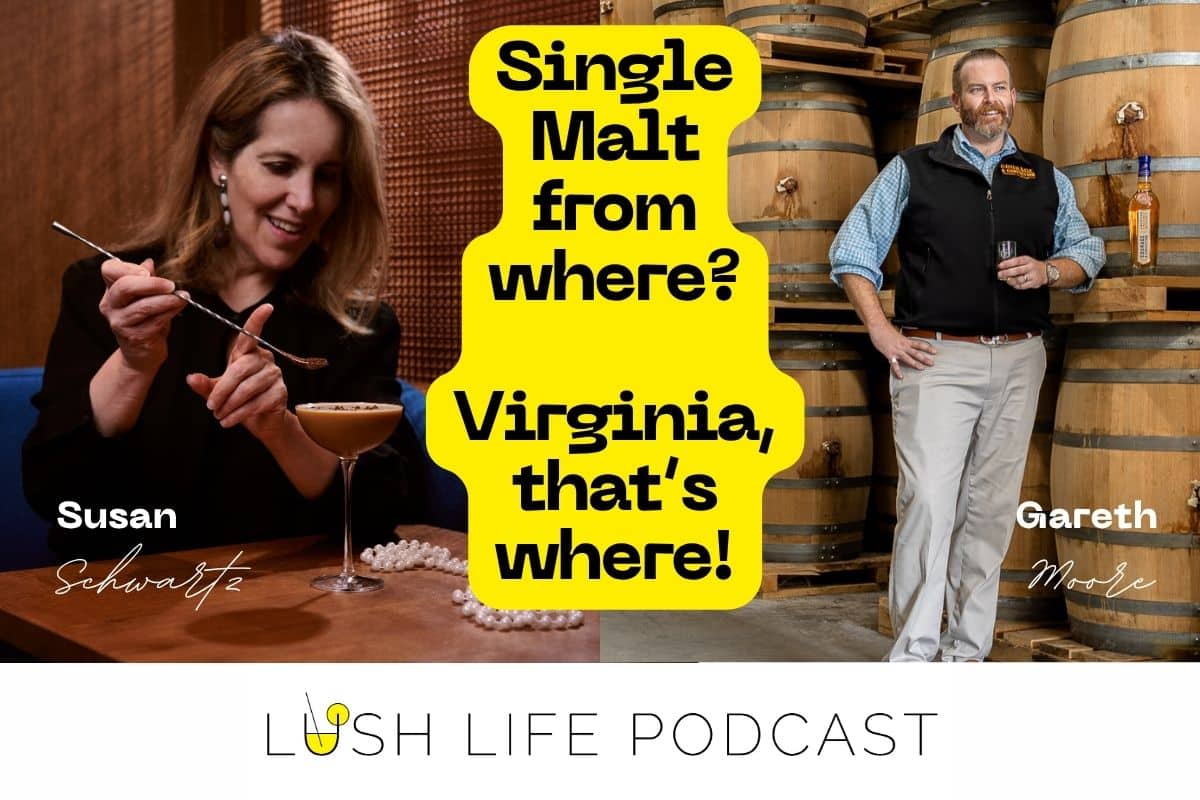
It takes a certain courage and a fair bit of conviction to build a whisky distillery that dares to do things differently. Luckily, today’s guest is genetically predisposed to have both.
Today I’m sitting down with Gareth Moore, CEO of the Virginia Distillery Company. With his father’s dream as the blueprint, Gareth has transformed an idea into one of the most exciting names in American whisky.
He guides us from his father’s story to what defines Virginia Single Malt whisky today!
Watch it on YouTube
Cocktail of the Week:
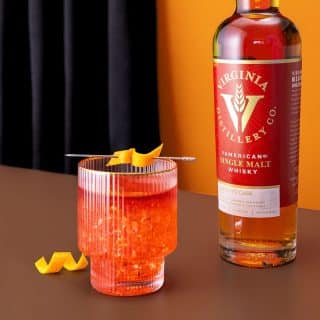
A Cab on the Boulevard
Ingredients
- 2 oz Virginia Distillery Co. Cabernet Cask Select
- 1 oz Sweet Vermouth
- 1 oz Campari
- orange peel
Instructions
- Combine all ingredients in a mixing glass with ice
- Strain into a cocktail glass
- Garnish with an orange peel
Nutrition
Please enjoy this transcript of my interview with Gareth. Just remember that I own the copyright in and to all content in and transcripts of Lush Life podcast, with all rights reserved, as well as my right of publicity. So if you want to use any of this, please email me!
This transcript is sponsored by:
Susan: Well, hello. It’s so great to have you on the show. Gareth, I’m so excited to talk all about whiskey, American single malt, all that stuff. Why don’t you introduce yourself to everyone and let’s start.
Gareth: Absolutely. Thanks for having me, Susan, and great to be with you. Happy to give a little introduction. I’m Gareth Moore, CEO of Virginia Distillery Company I’ve been doing that for, let’s see, coming on 12 to 13 years now. It’s been quite the journey and I expect it’ll continue to be, but that’s what I’m here to talk about.
Susan: All right. Well here at Lush Life, we start at the beginning. So why don’t you tell us a little bit about where you grew up, how you found your way into making whiskey.
Gareth: Sure. To be honest, it’s not so much my story as it is my family’s story, really. My late father, Dr. George G. Moore, he and my mother, were both born and raised in Ireland. They were high school sweethearts. Dad was a scholarship kid, got a scholarship to University College, Dublin. From there he got a scholarship, thanks to a professor of his who got him a scholarship to George Washington University in Washington, DC, which is where I was born.
So he came in 1972. My mother came a few years later. She also did her MBA at GW. Dad did his master’s degree and then two doctoral degrees at GW. He lived out the American Dream, which you certainly hear various positives and negatives about, as the American Dream is declared dead. from a limited sample size of one, I had the great privilege of getting to witness that growing up, of somebody who came to our country with literally just a couple hundred bucks and some hopes and a dream and a scholarship and did get to do quite well.
That’s the very, very earliest background. If I fast forward through the American Dream, he built out some tech companies. We lived in the metro DC area, took a little jaunt over to the West Coast, San Diego, for about eight years. Moved back east. in 2011, Dad sold his primary operating business. It was called TargusInfo which did a lot with data and analytics and caller ID and what have you, but not nearly as exciting as whiskey.
That same year, later in 2011, he decided that he wanted to take a lifelong passion for single malts, which are traditionally associated not with Ireland but with Scotland, particularly back in the day. He wanted to take that passion and his adopted home of Virginia and make the next great American whiskey.
Susan: It sounds exciting what he was doing. I am sure he was probably on the cutting edge of all that tech stuff, so that is amazing. Alongside all that tech stuff, was he always drinking whiskey? I mean, obviously he’s from Ireland, was Irish whiskey in the house a lot? What was his relationship to whiskey before he decided to start a distillery?
Gareth: It might’ve been easier for the marketing folks if he were Scottish or if he preferred Irish whiskey. funny enough, he was an Irish guy who liked Scotch whiskey. So that was what he was into – single malts. He was a big collector. In fact, we can trace it back to the year I was born.
Aberlour, which is a fabulous distillery, in 1982, one of their marketing folks had the vision of, hey, if we sell some casks this year and then bottle them in 2000, this far-off distance of the millennium, that’ll be an 18-year whiskey. My mother purchased a hogshead for my father in 1982. Every year they send some swag and barware and some samples. That cask of Aberlour was – even though the contents weren’t behind the bar – we knew about it growing up. Now, just as I’m thinking about it, the actual liquid, a lot of it is in my basement right now. It’s part of the millennium casks that they released in 2000. They also sold another batch in 1988 for some 12-year whiskeys. That goes all the way back to 1982. In terms of having a good amount of whiskey, the family now has close to 10,000 casks – not just one – but we can trace it back to, I guess, 43 years ago.
Susan: Oh my God. That’s incredible. Now, obviously a lifelong passion. How about for you, since you’re the one I’m interviewing – did you also love Scottish whisky or were you drinking beer and bourbon and stuff like that since you were American born and bred?
Gareth: Yes. If we went back to the marketing folks, right, that always want a good story, they would love if it was also my passion. I cannot tell a lie. It was very much an inherited passion. So I mean, you hit it on the head – beer, bourbon, anything under the sun. I was on the consumer end of it, not the aficionado end of it.
In fact, I could admit to a horrible drink that was my standard go-to my senior year of college: a Dewar’s White Label and soda with a lime. I don’t know where the lime came from. It hopped in there at some point. It’s funny to think about that – I have college buddies that know what I’m doing now and we will bring up the Dewar’s and soda with a lime from the early 2000s. That was the go-to.
I had no background in whiskey. Sure, I’d been to some distilleries with my father, knew some of the 101. I can’t say that I was a collector or an aficionado. I probably couldn’t say Islay correctly or tell you the difference between any sort of types of whiskey out there. So no, it wasn’t something that I had in my background. I didn’t have any background in consumer-type goods. I didn’t have a background in manufacturing, whether it’s food or beverage. Complete novice in all ways. So no, all this is Dad’s idea, not mine.
Susan: All right. Back to your dad then. So he sold his company, he decided to create a distillery, and I assume he always knew that he wanted to do some kind of whiskey.
Gareth: Yes. So you do what you like and you do what you know. Dad wasn’t a big bourbon guy, and he absolutely wasn’t big into having people tell him what to do or what he should do or what – this is the way things have always been done. That is a quality that I definitely have from him. If somebody tells me I can’t do it, then I’m definitely going to do it much harder.
He was really, I guess, not inspired by this idea of American single malt, but really by the idea that single malts had a great history. They had a great depth of different flavors and stories of where everything came from. It also had the story of exploration and moving beyond Scotland, right? I mean, American single malt is not the first single malt, by far, by decades – or maybe even a century – when you think of Scotland, even India.
In fact when we were building out the distillery, it was Kavalan, out of Taiwan, that was becoming the industry darling briefly. Being able to make those products outside of Scotland – we’re not the trailblazer there. There were many before us. Doing it in the US I think really provided that unique combination of what my dad liked in terms of the product but also continuing that very long tradition of immigrants in the US taking those old world stories and traditions and techniques and applying them in the new world.
Really importantly, not just trying to copy. Trying to replicate Scotch was never a success for us, right? When you think of food and beverage in the US – we have pizza, well, that’s Italian. Kind of. Or macaroni and cheese, or hamburgers or hot dogs. These all have their old world traditions. Those are each a hundred-plus years back. I like to think of even ongoing traditions. Something in the last 10 years – 30 years ago, some folks on the West Coast were eating raw fish. That would sound crazy if you didn’t wrap it in rice. Today we have sushi, and I could order from five places to be here for lunch in the next 20 minutes. If you took some of those things that I would be ordering online, like a Philadelphia roll – having cream cheese in there – I don’t know that they would approve in Tokyo. That would be very outside the norm.
My point is that copying an old world tradition and doing it here in the new world is not really what we do. We make it better. We make it for the American palate. We add cream cheese. Now we don’t add cream cheese to the whiskey – that’s just an example.
You get what I mean, right? It’s not about just copying something. It’s adapting it and really making it your own. I’m proud that our products can compete globally, but not out of pure imitation. Making something that is uniquely tied to a sense of place and couldn’t be replicated without really our climate and maturation environment.
Susan: Of course. Making it your own. You’ve led me so well into the next set of questions. How was he going to make it his own? Obviously, you’re in a different place, but maybe you can talk me through kind of his idea, where he started and then where he did make it his own.
Gareth: To be honest, there wasn’t a fulsome plan of exactly what the flavor profile was going to be – what kind of techniques and ingredients and so on – and that really adds up for Dad. He wasn’t a let’s-get-to-the-nth-degree-of-perfect-planning type. Don’t let perfect be the enemy of good enough; just dive in headfirst.
That was absolutely the way he went about business and many things in life. That was how the distillery was built out. When he was still living, obviously we got the land, got the stills, got some Scottish consultants. Unfortunately it was only 18 months into construction that he had a heart attack and passed. It was all very sudden – he wasn’t ill.
To be honest, I wasn’t working with him on the distillery. We had other things we were working on together. My background’s in finance, still is, still have a role there. At the time, Dad and I were working on what I thought of as more grown-up-type endeavors – investments in tech startups. Like, that’s not whatever lark Dad was working on down in Nelson County.
You know, hey, whiskey – you can buy whiskey at the store. It was never in my mind that it was something that I would be leading in any way, shape or form. I’m circling back to the reason I was saying that: there just wasn’t a plan of here’s exactly what we’re going to make the flavor profile. Like, here’s exactly how the branding is going to go. In fact, we did end up changing some of the basic pieces of the business plan.
He was focused more on: let’s develop inventory first before we release a product. We released a blended product using some distillate that we had imported. We built a visitor center concurrently opening when we started distilling, so that we could start building a brand around the business and so on. I’d love to say that there was a grand plan for exactly what the flavor profile was supposed to be like. The reality is we figured it out over time. Happy to go into exactly how we figured it out, because it is one part that I’m personally pretty proud of – how we were able to come down to that.
Susan: Of course, I want to hear that. That’s all part of the story. I just want to back up for a sec. You said he jumped into it – were there the basics?
Gareth: It was in process for sure. So for the water – in getting the land, that was definitely a prerequisite – getting the wells tested and so on. We were lucky enough to find a location with very high volumes of clean water. We are not too terribly far from Kentucky, so we have some of that limestone underneath us that has the impact of filtering the water to a degree. Yes, it does add calcium, but really, it’s the lack of iron that you’re looking for. Yes, that was present. The location down in Nelson County – they’ve called it Alcohol Alley before. The largest cider works in the state is down there. The largest craft brewery was very close to us. Several wineries. there were four distilleries in Nelson County, Virginia.
Having the local government understand what that is, understand the tourism associated with it, and then having a labor pool available was also an important ingredient there. Then plenty of land so that we could have room for warehouses. So we’re on a hundred acres in a valley. We say a hundred acres, but a lot of it’s just steep slope in the valley where you practically can’t really build anything.
Yes, those were some of the early starting points. Of course you’d say, okay, well how are you going to do that if you don’t really know where you’re going? Well, there were consultants. One of the most important ones was Harry Cockburn. He was the production manager for all of Morrison Bowmore, and he was the Master Distiller for Bowmore Distillery on Islay. He retired in the early nineties, but as his wife says, he’s very bad at retiring, because 30 years later he was still working with us. Harry – I believe he’s probably closer to 90 than 85 now – but he is an engineer, not a chemist or a romanticized distiller, but an engineer.
We’ve had a lot of folks at our facility who give a lot of compliments about how it was built, just in terms of the process flow, the way the piping doesn’t allow dead legs, The way there’s just a lot of continuity through the process. We have Harry to thank for that for sure. From there we got other consultants that really complemented what Harry was doing to get us to what’s in the bottle today.
Susan: Yes. For someone whose drink – and I am going to bring it back – was Dewar’s and soda with a lime, obviously you have these wonderful consultants, but kind of the buck stops with you. How did you know what was the right direction to go in, flavor-profile-wise?
Gareth: So I would say I had the blessing of being very, very, very, very naive. Probably like my father, a little headstrong. Even when I first went to visit the distillery – I had never been there when my father was living. It was only 18 months that it was under construction. It was kind of a shell of a building. The stills were there, because you put the stills in place and then build the building around it. No windows or doors. Everything’s on a catwalk, so the tanks and so on go deep under the apparent floor.
When I showed up, It’s like, hey, there are stills, there are some tanks – where’s the on button? Let’s start going here. Again, being very naive, I did not realize that there was a heck of a lot of work to do. When we say construction, we really mean engineering of the pumps and the valves, the piping, the boiler system, the chiller system. One of my first questions was like, why do we need both? Why don’t we get rid of one or the other? If we’re heating things up, why do we need to cool them down? Somebody explained it to me later.
The electrical system, the malt handling system, the malt storage – big old silos – wastewater processing. Didn’t know about that one. That was expensive and complicated. Then we had things like the warehouses. You make a bunch of whiskey, you’ve got to put it somewhere. So we built that out. Then the visitor center, which is kind of the heart of the distillery now – my wife built that part, so I can’t take credit there. Then eventually a bottling house, and now we have a vatting house. So it turns out a shell surrounding some stills does not a distillery make.
Susan: Was there ever a time during this whole process when you were like, what am I doing? Why am I doing this? We’re going to stop. Or was it just: this is my dad’s legacy, I just have to power through?
Gareth: It was always too late – it was my first rodeo. There were obviously plenty of mistakes that took time to learn that they were mistakes. Thankfully, never gave up on it. It took a long time, right? I mean, this was May of 2013 when Dad passed, and it was November of 2015 when we started distilling.
It was that period where we were building out the distillery and of course the business around it. what happened was we had a couple of different consultants. Harry was remote and kind of gave us the overview – he wasn’t there day to day, he was over in Scotland. We came to a really interesting point in the summer of 2015 when we were months away from starting distilling, we were building our warehouses, and we knew where they were going to go.
We had site planning and so on, but we needed to figure out what format they would be in. The question came down to the climate. The prevailing opinion was that you can’t make single malt whiskey in a hot climate. We’re not hot year-round – we’ll go above 110°F in the summer inside our cask houses; we’ve gotten as high as 106°F. Then the humidity is unreal in the summer. then the winter, it’s the opposite.
We’ll go down to single digits Fahrenheit and it’ll be very, very dry. The opinion was, well, that’s not how a single malt has been aged. Some people thought that it was going to be a very negative thing. You know, these thoughts that the hottest places in a warehouse in Scotland – the top – the whiskey can get sour and it’ll be negative. This is no good. Not knowing anything, it was like, yep, I’ll just take that advice.
We went down the path of building climate-controlled warehouses. I mentioned earlier Alcohol Alley – there are plenty of alcohol businesses nearby. So we started visiting neighbors, wineries and so on, where they would have climate-controlled warehouses. A lot of it comes down to the insulation, which is expensive, but not nearly as expensive as the active systems to heat and to cool.
Because a warehouse is a large open space – it’s a bit like going to a warehouse store like a Costco or a Home Depot or what you might call B&Q. It’s expensive equipment on the front end. It’s also expensive to operate. You can tell that I’m not a great marketer – I’d love to say that this was all about the flavor profile, but being a finance guy, it was like: this is expensive. This is very, very expensive to build these climate-controlled warehouses.
We’re going through all the specs and so on. In 2015, Kavalan won, I guess outright, Best Single Malt of the Year at the World Whisky Awards, which was huge because it was out of Taiwan, not Scotland or Ireland or Japan and so on. So it made a big splash. It really attributed the quality of the liquid to the maturation environment, which didn’t have the cool weather that you get in the winter – but rather a tropical climate year-round.
Again, I’d love to say in my mind it was, oh, it’s going to be great-tasting whiskey. No, it was like: this will be less expensive to build these crazy warehouses. That was a challenge with some of our consultants and folks that we were working with as we were building the distillery. I endeavored to find the person behind Kavalan – a guy named Dr. Jim Swan.
I was actually able to get in contact with him through a business school buddy of mine who was Taiwanese and had a wine distribution business there. We connected with Dr. Swan. I was very surprised to learn that he was actually Scottish – not Taiwanese. He agreed to consult for us. It wasn’t universal amongst our consultants – but it was with Harry Cockburn, because they had worked together on many projects, including Kavalan. So they were good friends.
We brought over Dr. Swan. We have reasonable scale now, but at the time when somebody came to the US, I went and picked him up at the airport. So I went up to Dulles Airport and picked up Dr. Swan, and I seemed to have learned everything I needed really during that drive – two and a half hours down to the distillery. Some of those little quotes from that conversation really stick with me today. Dr. Swan – who also passed, in February 2017, on Valentine’s Day – but some of these quotes really stuck with me. His emotion about it as well.
He was rather annoyed to learn that we were considering climate-controlled warehouses. He used the word ‘rob’ – Gareth, you’re going to rob the whiskey of an opportunity for a sense of place. He said that very emotionally, like he was angry with me. You’re going to rob the whiskey. What else did he say? Well, if you wanted to replicate the climate in Scotland, then why didn’t you just build the distillery in Scotland? This makes no sense.
Susan: Good point.
Gareth: Exactly. It does kind of go full circle to that idea that I started with – of making something your own versus replicating what they do somewhere else. That conversation obviously really stuck with me. He got into a lot of the specifics. We designed the warehouses – he was more than just a maturation expert. Really his background was most in depth on casks, different types of wood, and how the spirit interacts with the casks.
He had his specifics of the distilling process, of how we get that ready for the warm-weather maturation. It’s just a few simple things that we do. He specified really minimal insulation, no active heating or cooling for the warehouses – let the climate have at it, which is what we do. also really importantly came up with our recipe for our casks.
So we use roughly 50% former bourbon casks. Dr. Swan had a relationship with Brown-Forman that he connected us with, and, man, what is it, 11 years later we’re still using that exact same cooperage through Brown-Forman. Same with the STR cask – stands for Shave, Toast, and Rechar. He invented those casks. We’re not the first to use them, but I only recently – in the past year or so – found a distillery that wasn’t working with Dr. Swan that started using them.
I thought that was a great compliment to him that years after he had passed, people were still using his casks even if they had never met him. Then the last type of cask we use are sherry butts. We still today work with the cooperages that Dr. Swan connected us with.
So yes, that was the Dr. Swan recipe for success. He knew how a warm climate worked. He said he was excited to see what the cold climate would do for us. Really, with the heat you get the expansion of the casks and the spirit gets pulled into the wood. With the cold dry winters, they contract and spit the liquid back into the barrel. You have much more dynamic in-and-out interaction with the spirit and the wood.
Susan: Yes, I remember you telling me that when we met. Also you said that the angels are lucky because they get a lot more of the angel’s share – sadly for us humans, but happily for the angels.
Gareth: You’re probably being polite, because I probably said something much ruder about the angels. That really is a fabulous marketing term for lost profits. We have a lot of losses, and Dr. Swan told us to get ready for those, which we were in our financial model and so on. In four years – which is our standard for when we go to finishing casks in a bourbon cask – we learn we lose approximately 18%.
So that does slow down after the first four years, but that’s a rough four years to start. We obviously knew from Dr. Swan that that was going to happen and that our maturation curve would be a lot faster than in a much milder climate. That’s been a challenge for us with consumers and the market in general – to kind of break that preconceived notion that age equals quality and value. If we’re speaking from value – like dollars and cents – I’m happy to share the financial model that the liquid gets quite costly when you lose a lot of it. Then just on quality, I often ask people to do a blind sample. Don’t ask about the age until you’ve tasted it and passed judgment on its quality before you hear: oh no, it’s only eight years old. Well, you liked it, so that’s pretty good.
Susan: Yes. Yes, I remember you telling me that because of the high humidity it just zooms right along. Now let’s get into some of the expressions you have. Maybe you can take us chronologically through what were your first, how long, when was the first expression out, and then to what the more innovative things that you’re doing now. Even though everything was innovative, but – maybe I should use a different word. Maybe what’s newer, I guess.
Gareth: Yes, so like I mentioned before, we kind of changed the business model up a bit to really launch a brand before we had our own whiskey. We imported aged single malt from Scotland and then used finishing casks to kind of make it our own. We called that product Virginia Highland Whiskey – kind of mixing the Highlands and Virginia, obviously. Over time, as we had our own very young whiskey – 18 to 36 months – we started slowly, bit by bit, adding that into the liquid for the secondary maturation in port casks and cider casks and a few others.
That really gave us the kind of capacity and competency around blending. Because blending is a very, very, very important part of whiskey making. Learning that early was good versus later when we had our own juice. Yes, we definitely cut our teeth on that product. So that product line was around between, what, 2015 through 2021 or so. In fact it was so tasty that in 2019, the Scotch Whisky Association took grave offense that we called it a Virginia Highland Whiskey, because only they can use the word, Highland. So we had a very fun and exciting lawsuit.
Susan: A little slap on the wrist. Scottish style.
Gareth: We took our medicine. Yes. We changed the product name from Virginia Highland Whiskey to VHW. So that was the VHW product line. By 2020 we had five-year whiskey that we had aged ourselves. We released the first of the Courage and Conviction line, which is the more premium line. So everything’s divided into two parts. We have our house line, Virginia Distillery Company, that is all about finishing casks. Then we have the Courage and Conviction line that is the premium line, focused on primary maturation and tends to be a bit older. Starting with Courage and Conviction-
Susan: I love the name, by the way.
Gareth: It’s pretty good. If you say it loudly enough, you’ll see my golden retrievers. They’re named Courage and Conviction. They were born five years after the whiskey came out, but yes, the whiskey was not named for the dogs – vice versa. It was a saying that my father liked to use. I mean, he didn’t come up with it, he just really liked to use it.
It was the idea to have the courage of your convictions – meaning that if you have something you really believe in, you have a conviction, then let that be the power, the courage that drives you. That was a saying he liked to use and certainly was a big part of how we built out the distillery. So it seemed very natural – it just kind of fit. We went through all sorts of iterations. We had a marketing company that helped us come up with 150 of the worst names you’ve ever heard. We paid a lot for that report. We were going to use the least horrible of the horrible brand names. Our brand director at the time knew that the names we had were no good. She came up with Courage and Conviction, which worked out fabulously.
Susan: I love it. of course there’s a secret to the bottle, right?
Gareth: Of course. As I explain to some of my kids here, if you really love a toy – like a magnet – then make sure everybody else gets one. The medallion on the shoulder of the bottle is something you see in a lot of different whiskeys, primarily Scotches – whether it’s the Dalmore or GlenDronach, you’ll see kind of artisan artwork made into a medal on the side.
Again, I’m a finance guy, and so you’re going through the financial build and you’re like, man, that’s a nice piece, and it adds value and it’s expensive. It’s a pity people will throw it away. We made it so you don’t throw it away. It’s a magnet that attaches and you can pull it off. You can use it, put it on your bar fridge.
It could be part of storytelling – here’s the Courage and Conviction that we were enjoying when we were sitting around that campfire or having that reunion or get-together and that sort of thing. So that’s the signature malt. The way it works is that the signature malt is a cross section of the inventory that Dr. Swan had prescribed. So it is 50% of an ex-bourbon cask – those are first fills from Brown-Forman, not including any Jack Daniel’s, just their bourbons: Woodford Reserve, Early Times, Old Forester, and so on.
Then it would be 25% of the STR – the cask that Dr. Swan invented. So that is Shave, Toast, and Rechar. Those are European red wine casks that, after they’ve been used, are broken down. The hoops get knocked off and the individual staves are stacked up and then shaved on the inside. When they’re shaving the staves, they’re trying to do it to a very precise level – about three to five millimetres – where they’d like to shave deep enough where there is untoasted wood, so you’re getting past that initial toast that was done for the wine, but not too deep, because you want that fresh wood to be wine-soaked.
Once that is shaved, they recoop the barrel – it’s not always the exact same staves that go back together. Once it’s recoopored, they do a toast and then a flash char on it. It makes this kind of crust on the inside. The way I think about it is: if you take a steak and throw it on the grill, you can get those char marks. If you have a marinated steak, you’ll kind of get that crust of the marinade, this caramelization effect that draws out sugars. That really results in a nice whiskey.
That’s my favorite cask by far, so you can hear me waxing poetic about it here. Then the last 25% are from sherry butts. So again, those are also first fill – we get those from Jerez, obviously – and roughly a third, a third, a third between Oloroso, Pedro Ximénez, and Fino casks. So those casks are what compose the signature malt. Then within the Courage and Conviction range, we also have individual expressions of each of those casks. We have a few other sub-expressions, special releases here and there of casks that we’ve come across for a certain release.
Our Visionary Collection under Courage and Conviction is a Spanish red oak that we’ve come across that works really nicely. We have a Double Cask Reserve, which is a bit higher proof, with just the STR cask and the bourbon cask. Always have exciting things in the pipeline.
Susan: Yes. That STR cask sounds so amazing. It just is such a great idea, so innovative and it really brings something so different to the whiskeys. I can’t remember – when we met, was the cider cask Courage and Conviction or was that the other one?
Gareth: No, so that would be the house line under Virginia Distillery Company – what we call our house brand, because it’s just named for the company. Whereas Courage and Conviction is all about primary maturation – so in those casks for 6, 7, 8 years – the house style is an initial maturation just in bourbon casks for about four to five years. Then we take that liquid and transfer it into a different cask for finishing.
We have a port expression, we have that cider expression, we have a cabernet expression, and then we have a toasted oak expression as well. For the cider, it is a bit of a misnomer in being called cider, because it’s several different types of casks for that secondary maturation. We use French calvados, which is an apple brandy. We use American apple brandy from Laird’s – Laird’s is the oldest brand or distillery in the United States, and luckily, it’s only about 15 miles north of us – so we get those casks pretty wet with apple brandy.
Then the rest uses a combination of primarily dry and some sweet cider. Those are all different types of apple casks. we didn’t want to call it apple whiskey because people would think it was more like a flavored whiskey, like Jack Daniel’s Tennessee Honey or Crown Royal Apple. So we went with cider, and I think that does give the essence of what’s going on there with all those different apple casks without overpowering it, right? We do like the whiskey to be able to speak through all those casks, not the sweet flavors of something that might be flavored.
Susan: Just so everyone knows – I met Gareth a few weeks ago and we went through tastings and it was divine and everything is so yummy. The cider cask, the nose is pure apples and the taste is pure whiskey. It is just such a wonderful combination. So I personally am very happy that you did it.
Gareth: Thank you. It’s great to hear. Really, for all of our whiskeys, but particularly in the finishing series, our lead blender Amanda Beckwith is really the artist behind it. There is a lot of science in distilling, particularly, and some in aging. Once you get to blending, you’re mixing art and science. as you might have gathered, being a finance guy, I’m more on the science than the art side. Amanda really takes the ball and runs with it. She has an amazing palate, she’s trained with some of the best in the world and is able to tease out different flavors from casks and put them in the right combination for a really great expression.
Susan: Well, this one is – now, are you working on anything new that you could tell us about, or is that the newest?
Gareth: We always are, for sure. You know, it’s an interesting thing about working on new things – you have this balance of not wanting to go all in on a product approach because you don’t know how good it’s going to be. Then on the other hand you can have something that is good and it’s like, oh no, we didn’t make enough.
Given the timelines around whiskey, that really becomes challenging. So I’m thinking through – I know that there are a brandy cask or three from our early days that I don’t know what was going on with those casks, but it’s nearly inert. Might as well put it in plastic or stainless steel. It hasn’t really done much. We have some rum casks that are amazing – they’re just taking forever to go anywhere.
If that becomes our big fan favorite, we’re going to have quite the issue with the time machine making more. We’ve gone the wrong way with Chardonnay before – we had some good casks, we had some very bad casks. Anything new that we’re trying, we’re always facing that awkward prognostication of: is it good enough that we’re going to want to have plenty of it, or is it going to miss the mark – and oh no, we have plenty? It’s kind of an awkward balance.
In the Courage and Conviction line, we have about 1% that we’ve allocated for experimental casks. So anything that’s not part of the normal – sometimes we’ve done more, sometimes less – but we’ve played around with a lot of different types of sherry: whether it’s Amontillado, or I guess a Madeira – a type of fortified wine, maybe not technically a sherry but a fortified wine.
We’ve gotten into Marsala as well. Now in the finishing series – the house line – that is much easier, because you’re not waiting 6, 7, 8 years. You’re waiting somewhere between six to 24 months on the finish.
Our recent expansion in that line has been with beer finishes. That’s been a really interesting opportunity. We call the line Brewers Coalition, because we work with different breweries around the country. It’s really interesting because again, you’ll have the marketing folks say, hey, this is a great operation that we’d love to be co-branded with. Then when the rubber hits the road, they have to be able to make a high-quality product and take good enough care of their casks so that we then get a great product together.
I believe we have about half a dozen of those this year that are all limited releases. We have Goose Island out of Chicago, Boulevard Brewery out of Kansas City – a good range of those that we introduce. Generally most of those cases go to the relevant markets, and then we kind of sprinkle the other cases around the country. It’s neat, because who’s ever heard of a random distillery in Virginia? Well, if we partner with a local brewery, then it kind of shows what we’re able to do and gives us that kind of credibility. So yes, those have been some of the most recent expressions.
Susan: They sound so interesting. They really do. I’ve never tried anything like that. So next – hopefully you’ll do one with a Pennsylvania brewery, so the next time I’m in Philadelphia I can have some. Before I let you go, I’d love to hear more about the experience that people can have when they come. Because if someone’s listening and they happen to be in Virginia or planning a trip to Virginia soon.
Gareth: Yes, absolutely. So that’s definitely been a big part of the distillery – being able to visit a location, do a tour, and interact with it, because it is somewhat unique. Most people don’t have traditional Scottish pot stills in a distillery. Most people are making American single malts and we are at a reasonable scale compared to a lot of craft distilleries. We actually are officially the Virginia Whiskey Museum.
We have a museum in the basement of our visitor center that goes through all the history of not just our company, but all of the whiskey in Virginia over the years, going back to George Washington and some of the Scots Irish that came and settled the area. We are located in a town called Lovingston, Virginia, that is about a half hour south of where I’m sitting right now in Charlottesville, Virginia, which is where UVA – University of Virginia – is located, and Monticello, Thomas Jefferson’s home.
When people come to visit, obviously we can go through flights of all the tastings. I think the best part is actually getting to look and smell and taste and feel what the production process is like. Of course that’s one thing when you’re in the distillery, but it’s much more exciting when you’re in the cask houses, when you actually get to taste it as it’s finishing.
It’s a great, great experience. We always try to get partners that we’re working with – distributors and importers – to visit, because it’s one of those things that’s difficult, like many places, to do justice with just a website or some photographs. Actually being able to come and experience it firsthand. I often tell people, spring and fall you get three weeks in the spring, three weeks in the fall – they’re really, really nice. If it is that sweaty-hot August, there is something about understanding: okay, this is what’s happening to the casks. They are expanding and contracting and sweating just like I am. Getting to really experience that.
Susan: Yes. It’s such a tribute to your dad and his hard work, his courage and conviction, which obviously runs through the veins of the whole Moore family – because you’re sitting here having a lot of courage to do something that wasn’t even your idea and win awards and have all of these wonderful whiskeys at hand. So I really salute you for taking that and running with it, because the easier choice would’ve been to say, you know what, forget it, we’re not going to do it. It really is a testament to your dad.
Gareth: It might have been the smarter choice as well but thank goodness that I was naive and I thought it was going to be easier than it has been. Certainly being where we are now and having the relative success that we are is very fulfilling. Above all, it’s really the quality of the liquid. I know Dad would much prefer high-quality liquid and selling what we are now versus selling everything around the world but having suboptimal liquid. So that’s definitely a fulfilling thing. When I’m on the road and working with distributors and retailers and so on, it is pretty rare to not get a smiley face after somebody tastes the whiskey.
Susan: I don’t think that would’ve ever happened. That would always be great liquid. I can tell – that’s just the Moore thing. All right. It’s moreish – can I say that? It’s moreish.
Gareth: There we go. There we go. I appreciate that, for sure.
Susan: Well, thank you so much for sitting down with me and taking the time to tell me your story.
Gareth: Absolutely. I enjoyed it and appreciated the opportunity.
Susan: So hopefully see you in London, or maybe I’ll come over to Nelson County.
Gareth: Why not both?
Susan: Both. Exactly. I like that thinking. Courage and Conviction.
Gareth: That’s right, that’s right.
Susan: All right. Thank you again, Gareth.
Gareth: Cheers.
Don’t miss out on any Lush Life episodes!
You can get this and all future audio files automatically downloaded to your mobile device easy. You can listen on Apple Podcast or Spotify too. Or click the player or link above to listen to just this episode. (But trust me, you’ll want to subscribe!)
If you live for Lush Life would you consider supporting us… Just go to https://substack.com/@alushlifemanual and you can donate once or monthly to make sure we are still here almost every other Tuesday.
Lush Life Merchandise is here – we’re talking t-shirts, mugs, iphone covers, duvet covers, ipad covers and more covers for everything! and more!
Theme music for Lush Life is by Steven Shapiro, and used with permission.
Lush Life is always and will be forever produced by Evo Terra and Simpler Media Productions.