

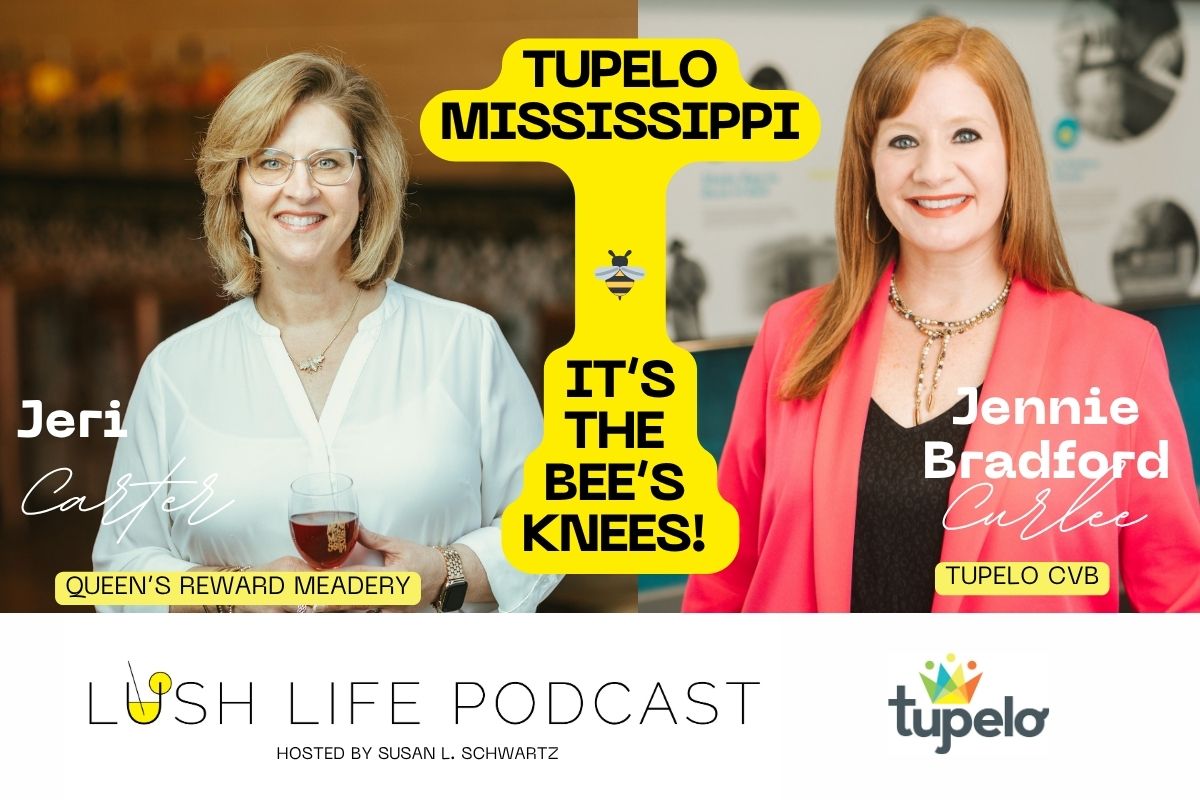
You just can’t help falling in love with a town that gave us both the King of Rock n Roll and the Queen Bee. This episode brings us the delights that can only be found in Tupelo, Mississippi.
Sponsored by Tupelo CVB, we’re diving into the history, restaurants, drinks, and experiences that make Tupelo on your go-now list.
First up, we have Jennie Bradford Curlee, the Deputy Director of the Tupelo Convention and Visitors Bureau. A lifelong resident of Tupelo, Jennie Bradford joined the Tupelo CVB in 2012 and now heads it all up.
After she gives us a tour around Tupelo, we are joined by Jeri Carter, the Queen Bee of Queen’s Reward Meadery.
Jeri Carter founded the Meadery in 2016, and all the meads produced are made with Mississippi Honey. Since its inception, Queen’s Reward has won over fifty medals in National and International mead and wine competitions.
Watch it on YouTube
Please enjoy this transcript of my interview with Jennie Bradford and Jeri. Just remember that I own the copyright in and to all content in and transcripts of Lush Life podcast, with all rights reserved, as well as my right of publicity. So if you want to use any of this, please email me!
This transcript is sponsored by:

Susan: It’s really great to have you on the show, Jenny Bradford. I’m so excited to talk about Tupelo.
Jennie Bradford: Absolutely. I am excited to be here. I’m Jenny Bradford Curlee and I serve as the Deputy Director here at the Tupelo Convention and Visitors Bureau in Tupelo, Mississippi. I have the privilege of sharing Tupelo’s story with international media, with tour operators all around the world, and visitors to Tupelo that are here to see all of the wonderful things we have in our city.
Susan: Fantastic. I know someone very famous who was born there, but maybe you tell everyone who that is and then get into some of the things you can do there.
Jennie Bradford: Of course. Elvis Presley was born in Tupelo, and of course everybody knows Memphis, but Tupelo’s just 90 minutes from Memphis. Elvis was born here in 1935 in a small little shotgun shack in East Tupelo. He lived here for almost 14 years before the Presley family moved to Memphis. Really his formative years were in Tupelo.
You can come here, you can tour the home where he was born. It’s still in the same place that it was when he was born there. They also have a wonderful museum on the grounds that chronicles his life. They have rotating exhibits that tell you what life was like in Tupelo, or they focus on something unique about Elvis.
They also have the original church that Elvis attended where he was deeply influenced by gospel music. That was his favorite genre. That’s what he won his Grammys for, his gospel albums. The preacher there at the church taught him how to play the guitar. That’s an exciting part of that Elvis experience.
Those are the ticketed items at the birthplace. There are actually about 10 to 12 other exhibits that you can enjoy that are all free. It’s a wonderful time just to sort of slow down and see what life was like for the Presleys in the thirties and early forties when they were living here in Tupelo.
We don’t just stop at the birthplace. We have an Elvis Tupelo driving tour that takes you to 15 different places that were an important part of Elvis’s life growing up in Tupelo. You can go see where he went to school. You can go see where he sang on the radio for the first time. You can get to Johnny’s Drive-In, which is Tupelo’s oldest restaurant. They still have the Elvis booth, so you can actually sit where he did.
Susan: No way!
Jennie Bradford: Yeah, it’s great. You sit there, you eat a cheeseburger like Elvis would have, maybe drink a milkshake, and just enjoy the nostalgia that is Tupelo’s oldest restaurant where Elvis loved to eat. There are lots of great places to explore. The newest marker on that driving tour, we opened just this past August, is Relics Antique Marketplace, which is located in the former Tupelo Garment Factory.
That’s where Gladys Presley worked when she was pregnant with Elvis. Today it’s a two-story antique and collectibles mall that has hundreds of booths where you can shop for everything from antiques to collectibles to Elvis memorabilia, vintage clothing, all kinds of fun stuff. We find that our visitors absolutely love stopping at Relics and having that experience.
Susan: It sounds like so much fun, and I don’t think there is anyone out there who isn’t an Elvis fan. I mean, even if you don’t know his work that well, obviously you’ve heard of him, and I’m really touched that the church is still there and available, and it must be a wonderful experience to be in that space.
Jennie Bradford: It is, and we find that visitors really get into that. You sit in the church and it’s a little bit of a surprise. There’s a presentation that happens, and I’m not going to give all of it away because we want you to come see it, but they invite you to sing along and just to feel the gospel rhythms like Elvis would have when he was here.
Susan: That’s so exciting. You also brought up the hamburger, so I’m sure there isn’t just one place to eat in Tupelo. Tell me about the food scene.
Jennie Bradford: Absolutely. We are a town of about 38,000 people, but so many people come into our community to work every day that we swell to well over a hundred thousand. We like to call ourselves a small town with big city amenities, which means we have over 200 restaurants in Tupelo. Everything from good old Southern cooking – we call it a Southern meat and three that people like to have at lunch.
It’s where you get to pick your meat, whether it’s fried chicken or meatloaf or all those southern favorites. Then you pick your vegetables that go along with it. We often tell people, especially if you’re a vegetarian, you have to be careful in the south because even our vegetables can be unhealthy, they can have meat in them. We love to cook with bacon. But you’re never going to have a bad meal.
We have everything from, like I said, the Southern food, to a wonderful Indian restaurant, to lots of Asian restaurants, Mexican, everything in between. Then of course we have fine dining. You’re just a little taste of everything here in Tupelo. Our culinary scene is special and it’s constantly evolving and there’s always something new being added.
Susan: From 38,000 it grows to a 100,000. That’s a massive difference. Is that every day?
Jennie Bradford: During the work week! We have hundreds of industries here in the area, so a lot of people come here to work in our different manufacturing areas. We’re a hub for manufacturing for the state of Mississippi, and we have the largest rural hospital in the country here in Tupelo, so a large medical community. We’re the county seat for Lee County, so we have a large legal community as well. Lots of different opportunities for employment, which brings people into our community.
It brings corporate salespeople in to stay in our hotels and to eat in our restaurants as well. We are a very diverse, very progressive community, and it just creates lots of great opportunities for locals and visitors alike to experience Tupelo.
Susan: Yes, I’m sure. I heard hamburger and went right to the food and I skipped over the music. But back to Elvis and the music in Tupelo – there must be tons of different venues where you can hear all kinds of music.
Jennie Bradford: Absolutely. We have 16 live music venues currently, and everything from small, intimate venues where you can hear an acoustic guitar to a 10,000-seat arena where we have national musical acts that come through. Almost every day of the week you can hear live music. We have a great brunch place called Brick and Spoon where there’s an acoustic guitar player every Saturday and Sunday playing everybody’s favorite tunes while you have great brunc with, of course, wonderful Make Your Own Bloody Mary Bars and mimosas and all of that, along with the southern breakfast favorites.
Then we have a place called Romie’s Grocery that has this amazing patio and they have live music on the weekends, more rock and blues and all that kind of stuff. Blue Canoe is Tupelo’s home for original live music. They bring through national and international acts. They’ve hosted people like the Alabama Shakes, Gary Clark Jr., and others who, right before they made it big, played on the Cathead stage at Blue Canoe.
The owner there, Adam Morgan, has a great ear for music and has brought incredible talent to Tupelo over the years. They also have an amazing menu of eclectic bar food. You’re going to go to Blue Canoe, they’re going to fill you up with good mood food, and then you’re going to hear great live music right there at Tupelo’s home for original live music.
Susan: I love that – good mood food. I’ve never heard that and I love it and I may take that as my own.
Jennie Bradford: You are welcome to take it.
Susan: As well as good mood food, there must be good mood drinks. I think everyone knows this is a drinks podcast and I write about drinks, and that we’re going to talk later about some mead with Jeri from Queen’s Reward Meadery. But tell me about some of the bars and the connection to spirits, not only mead, but other spirits. What’s going on there that may be innovative or even historic?
Jennie Bradford: Right. We have lots of great bars and restaurants with really talented mixologists that are creating unique drinks throughout the city. One thing you’ll find in Tupelo is that collaboration is a part of everything we do. We call it the Tupelo Spirit. You may see Harveys restaurant, their bartenders creating drinks with Queen’s Reward Mead, or they may partner with another local restaurant to pair their cocktails with something they’re serving there.
There’s a lot of collaboration in our culinary scene. Jobos is a restaurant in downtown Tupelo. It’s located inside Hotel Tupelo, which is a wonderful boutique property located in the heart of downtown. They really have seasonal cocktail menus. One of their most famous drinks is called The Daisy, and it’s their take on a margarita. It’s like a house margarita, but it’s all made with hand-squeezed juices. They really put a lot of thought into all the cocktails that they do. The Daisy is featured on our Tupelo Cocktail Trail, which takes you to seven downtown restaurants and bars.
You can either pick up a cocktail card at the Tupelo Visitor Center, or you can use the digital passport that’s available on your smartphone. You go to each place, you try their signature cocktail, so you would try the Daisy at Jobos. Once you’ve completed the trail, you come back to the Tupelo Visitor Center and we give you a custom My Tupelo cocktail shaker as your prize for drinking all the drinks. They’re all walkable, so we’re not asking you to get in your car after enjoying the cocktails. It’s a really fun way to try different things.
You’ve got The Daisy at Jobos. You’ve got the Tupelo Honey at a restaurant called Park Heights Restaurant that has a rooftop bar that overlooks all of downtown Tupelo. It actually overlooks Fairpark, which is where Elvis came back in 1956 and 1957 to do his homecoming concerts, and we’re celebrating the 70th anniversary of that homecoming concert in September of 2026.
While you’re enjoying the Tupelo Honey, which is actually made with Cathead Vodka, which comes from Jackson, Mississippi – named after Tupelo, but made with local spirits from our state – you can enjoy great live music on the rooftop as you overlook Fairpark, and it’s just a great way to experience downtown while enjoying amazing craft cocktails on the trail.
Susan: Fantastic. Can you tell me maybe one or two other cocktails on the tour?
Jennie Bradford: Absolutely. Amsterdam Deli and Grill is a Mediterranean restaurant in the heart of downtown. They have a drink called the Jordan River and it’s made with vodka, some citrus, topped with a little prosecco. It’s one of my favorites on the trail. Fairpark Grill is another local restaurant in downtown. It’s located next door to Park Heights and they have a Lemon Meringue Pie Martini that’s on the trail, and that is just fantastic. Every drink is a little different. We have a restaurant called Loco Taco that offers another margarita that’s on the trail.
Every restaurant’s a little different. You have some that are bourbon-based, some that are vodka-based, some tequila, so you’ve got a little bit of everything along the trail, and all the different restaurants put their own unique twist on the cocktail. We also offer opportunities for them to update those cocktails. We do a special edition holiday cocktail trail around Thanksgiving, the end of November, going through the month of December. Each year you can try a little something different with the Tupelo Cocktail Trail.
Susan: I always think I’m so lucky to live when I do, being a cocktail lover, because so many towns have taken this idea of a cocktail tour and just run with it. It’s a great way to see the city. All those cocktails sounded so amazing. I can’t wait. I’ve never been to Tupelo, everyone, so it’s just making me want to go more and more now. I know that we’re going to talk in depth later with Jeri about Queen’s Reward Meadery.
Jennie Bradford: She’s doing amazing things and I can’t wait for you to talk with her more. One thing that they do at Hotel Tupelo – they’ve partnered with the hotel and when you check in in the afternoons, they give you a taste of Queen’s Reward Mead.
It’s just a little taste that will hopefully whet your appetite to go out to the Meadery, enjoy the tour and tasting that they do there, and all the different varieties that they have. It’s another example of the collaboration in the community – you get to try it at Hotel Tupelo and they even sell bottles there at the hotel if you don’t get the opportunity to go out to West Tupelo where the Meadery is located.
Susan: Oh, I think everyone should, even if one doesn’t drink, to be able to have the experience of the honey as well, which you can only find that taste of honey where it is, because obviously the bees collect locally. Is there anything else that we’re missing that we can do in Tupelo that you can tell me about, or some fun festivals or anything?
Jennie Bradford: Definitely. Tupelo is known for Elvis, but we’re also the headquarters of the Natchez Trace Parkway, which was just named the fourth most visited national park in the country. The Natchez Trace starts in Natchez, Mississippi. It’s 444 miles from Natchez all the way to Nashville, Tennessee.
It’s a beautiful parkway. It’s two lanes, it’s a slow pace, canopies of trees, wildlife. You can learn about centuries of history along the Trace, whether it’s the original first Americans who lived along the Trace, or the first European settlers who came to the area, American Civil War history, or you may just want to hike down to where the dogwoods bloom in different areas of the Natchez Trace. Lots of different things to see. It’s a beautiful national park, but it is headquartered here in Tupelo.
In March of 2027, we’ll open the Chickasaw Heritage Center. This is going to be accessible from the Natchez Trace Parkway. The Chickasaw Heritage Center will tell the story of the Chickasaw Nation from their perspective. Tupelo is the heart of the homeland of the Chickasaw Nation, and they are coming back to the homeland to tell their incredible story through this beautiful $60 million interpretive center. We’re very excited about the opening of this new attraction in Tupelo as well.
As far as festivals, we are in the midst of festival season right now. It starts at the end of February and really goes throughout the year. We have our Tupelo Elvis Festival the first full week in June every year. That’s an international festival. It celebrates Elvis’s lasting impact on popular culture through live music events, through Elvis tribute artist contests and concerts. We have a youth Elvis Tribute Artist day where they learn to compete and learn to do all the moves and sing like Elvis, and it’s just lots of fun.
All of our downtown merchants and retailers get into it, and we host live music at a venue called The Depot, where it’s a free live music event that you can come out and participate in. Elvis food, Elvis music, and Elvis everything in between, all throughout.
Susan: That must be massive.
Jennie Bradford: It’s a big event. It’s sort of the culmination of our festival season and people from all over the world come to experience it right here in the birthplace of Elvis.
Susan: I know I would love to see all the Elvis impersonators who show up.
Jennie Bradford: It’s amazing just to see all of them.
Susan: I’m sure there must be one from like each era, so it’s not all one kind.
Jennie Bradford: They’re Elvis tribute artists, not just Elvis impersonators. When they call themselves tribute artists, they’re truly paying tribute to Elvis’s legacy, and they have the different jumpsuits or attire from different eras and they know the version of the song from that year in that outfit. It’s really amazing to see and to hear these guys perform.
Susan: Oh, they get so micro.
Jennie Bradford: It is incredible.
Susan: Well, it just sounds so wonderful. I love the south. Sadly I haven’t been to Tupelo, I haven’t been to Mississippi, actually. It’s someplace that I’m desperate to go. It sounds wonderful. Everyone, after hearing this, they’re going to immediately want to go, and we’ll talk to Jeri in a sec about the Meadery. Thank you so much.
Jennie Bradford: Absolutely. If people are interested, they can visit Tupelo.net to learn more about all that our city has to offer, and we’ll just have to get you to Mississippi at some point soon.
Susan: I would love it. Again, thank you Jenny Bradford for being here. I really appreciate it.
Jennie Bradford: Thank you, Susan. I enjoyed it.
Here is Jeri from Queen’s Reward Meadery
Susan: Hello. It’s so great to have you on the show, Jeri. Thank you so much for joining me. I’m so excited to hear about Queen’s Reward Meadery and how you started and everything. Why don’t you introduce yourself to everyone.
Jeri: Yes, my name is Jeri Carter. I am owner and Queen Bee at Queen’s Reward Meadery in Tupelo, Mississippi. We make mead. In case your listeners do not know, the legal definition of mead is any alcoholic beverage where the main fermentable is honey. In our case, we make wine from honey. We are a winery, we would just start with honey instead of grapes.
Susan: Of course. Now you have to start way from the beginning because this is Lush Life and we start at the beginning. Are you from Mississippi? Where, how did you get here and why did you even start it?
Jeri: I did not grow up in Mississippi completely, but I’ve always lived in the south, the southern part of the United States. Wound up in Mississippi, gosh, probably when I was 16, graduated high school here, moved to Tennessee, moved to some other areas around here. I think when I moved back to Tupelo this last time, I think it was a third or fourth time, and I just keep winding up back here.
This is evidently where I’m supposed to be. I’ve lived in Tupelo and in Mississippi a long time. I grew up in a very strict Southern Baptist family. There was no wine, alcohol of any kind growing up. It wasn’t that it was such a horrible thing, it just was not around.
Obviously in college and beyond, I would experiment some with drinking. I married my husband 22 years ago. Just celebrated our anniversary last week actually. Was not a big drinker growing up. Of course, as an adult I started drinking and enjoying some alcohols. It was okay. It wasn’t completely taboo necessarily with my family. It was just not something that I was around.
My husband’s family is German, and it was very interesting to me when we met and started dating. We would go to dinner at his family’s house and part of the meal planning in their family was that you didn’t only plan for the food, but you also planned for the beverage that was going to go with the food. That was a whole new concept for me, because we always just had sweet tea. That was just what you had. It was new and exciting and I really enjoyed seeing how the different beverages were partnered and paired with the different foods that we were eating in the different courses. It intrigued me.
Fast forward, way ahead. The way we got started making alcohol, making wine – I tell people I was teaching kindergarten and first grade, and we started making alcohol at home, which is our backstory because one led to the other.
We actually started by making just wine kits. You can buy these kits and it has the grape juice and instructions, and you just do step A and step B. That’s what we did. We were making these and had made two or three kits and we just thought we were getting good at this. We were trying to figure out a way to make wine without a kit. Can we do this all by ourselves?
Well, the problem is, in Mississippi, you cannot grow great wine grapes. There are a few grape varieties that will grow here. They don’t make a wonderful wine. They’re okay. But even those I didn’t have. I start searching the internet to find recipes for something that I could source locally to make a wine with. And I found a recipe to make wine from honey.
I’m like, oh, we’ve got great honey. I went to the grocery store and I bought some honey. It probably, looking back, wasn’t even good honey. It was probably more corn syrup. I didn’t know. I just buy the biggest jar I can find and bring it home. I did not realize, when we started down this path, that wine made from honey and mead were the same thing. I did not realize that at first.
After I did a little more research, by the time we were actually making the product, I knew that. We were in our kitchen making this batch with honey, and my son comes down the stairs. He’s probably 16 or so. He is like, what are y’all doing? I’m like, we’re making wine from honey. He said, oh, you’re making mead. And I’m like, excuse me – how do I not know that this is mead?
Susan: Right.
Jeri: He’s like, no, it’s in all my video games, ’cause he’s playing these video games. I thought that was funny – they have these mead halls. Anyway, we made this first batch. It was okay. I didn’t know. I didn’t have any idea what it was supposed to taste like. I had never tasted wine made from honey at all. We made our first batch. It was pretty good. Not great, but it was okay.
I went to the liquor store to buy some mead so that I could compare, ’cause I didn’t know if we had done a great job or a terrible job. I had no idea. When we got to the liquor store, we realized that you cannot buy mead in the state of Mississippi at all at that time. In order to buy alcohol in the state, it has to be approved by our state powers that be to allow it in. There was one on the approved list and evidently this place was not in business anymore because no one could get it. That was the first time the thought crossed our minds that there might be an opportunity here.
Now I will be totally honest with you and tell you that first batch that we made tasted more like moonshine than mead. It was strong. It was very strong. But it got consumed. I’m not a quitter. We finished it, but it was not the best thing I had ever had. We kept playing with this in our spare time and experimenting with different recipes and the information out there on the internet at that time – this was probably, maybe early 2000’s, I guess. Maybe 2010s, I don’t know, somewhere in there. The information on the internet, one blogger would say, whatever you do, make sure you do this. And the next article you would read would be, whatever you do, don’t do that, so it was a lot of trial and error.
We just kept experimenting and playing with our recipes and we knew that we liked what we were making better, but still, I really didn’t have a reference for what the rest of the world thought was good when it came to mead.
In 2016, there was the first ever American Mead Makers Association’s Conference, so there were enough commercial mead makers and home mead makers in the country to support this conference. It was during our spring break, so we had a week off of school. I was still teaching. We bought tickets and we took off to Colorado to go to this conference. Just to – ’cause we were still playing with do we want to try to do this professionally, or we just didn’t know.
Susan: Had you still not tried any other state’s mead? Still none. You didn’t even decide to go say, oh, I’m going to go to Tennessee?
Jeri: We would look around as we would travel. If we found any, it was usually more like a beer and not really like a wine, which is still mead. It’s just a different approach to the craft. But I don’t like beer, so I don’t want to make beer, so that was a factor.
We finally got the opportunity to go to this conference. We’re at this conference and there’s all these different meads. Some from professional mead makers, some from other home mead makers. We did not bring any with us ’cause we were just observing and learning.
As I’m getting to taste these other meads, I tell my husband, I say, Jeff, I really think ours are in the ballpark. I think ours might be as good as these. Of course, here’s the problem. Is it good or is it good because it’s yours? Like, my kid is the cutest kid in the program, but the mama sitting next to me is going to argue with that.
Susan: I love it. 100%. Is it just good to us?
Jeri: Exactly.
Susan: But to the rest of the world?
Jeri: While we were at this conference, we heard about a competition that was coming up in New Hampshire. It was an international mead competition, but amateur mead makers could enter. When we got back from this conference, we entered this competition. We sent some of the ones we were making at home into this competition, ’cause I thought, this is honest feedback.
These people don’t know me. They’re not worried about hurting my feelings. They’re going to tell me what they really think. We wound up winning, I think a silver and a bronze medal – second and third place – at this competition. I was like, okay, I think we’re on to something.
We had already started some of the paperwork process. Several mountains of paperwork later – yeah. If you aren’t drinking before you start that process, you will be by the time you’re done. Several mountains of paperwork later. When we got home and got the results from that competition, we went ahead and got our LLC to start our business. We’re about to celebrate our 10th birthday from when we got that LLC, but we still had a whole lot of work to do to get all the paperwork in place and to get recipes perfected.
In the state of Mississippi, the law says I can only sell our product where I make it. We were making it out in the shop behind our house to start. It was my husband’s man cave that I took over and made into our mead cave. Neighbors don’t really like people driving up at all hours buying alcohol – I don’t know why, but homeowners associations frown on that.
We really didn’t launch our product to the public until 2018 when we actually had a space and had a tasting room, and we weren’t doing it out of our backyard, which seemed a little weird. But we were selling a little to family and friends, but not much. That’s how this all started.
Okay, let me back up. I was still teaching school during all this. Here’s the rest of that story. I was very, very fortunate in that I had the opportunity to stay home with my children when they were little and not work. I had started teaching ’cause they were old enough to go to school and things. The problem I was facing at that time was my 50th birthday was on the horizon, but I still had 20 years before I was going to reach retirement age in the school systems. I was teaching little ones like five year olds. I’m going – one of us is not going to survive this and there’s a lot more of them than there are of me. We might need to come up with a plan B here. This was plan B. The goal was we were going to start the Meadery. We were going to be open on Thursday nights, Friday nights and Saturdays until it really got going. If it was successful, I would stop teaching and do this full time. That was the plan.
We launched in May, right as soon as school’s out in 2018. Still planning on going back to work in the fall. I don’t know if it’s like this everywhere, but people in Mississippi and people in Tupelo, they’re nosy. They had been driving by watching all the renovations we were doing on this space. We had lots of people coming in to see what was going on. It was great. The problem is you don’t know if they’re coming back. You just know they’re coming in to see. We were really busy even right out the gate.
We opened in May, and towards the end of June, I’m looking at my husband who’s still working full-time at his real job. I was like, if it’s going to be like it is right now, I don’t know that I can handle both of these. This is a lot. I’m not sure what I need to do here. He’s a serial entrepreneur. He’s done a lot of this sort of thing. He looked at me and said, Jeri, you’re either all in or you’re not. You can’t do this halfway, you’ve got to make a decision. Which was terrifying.
I was like, okay, but if we do this full time, that means we’re all in on your paycheck, ’cause mine’s about to go away for a little while. He agreed. I called my principal – we start school in August, so this was July, getting into the first and second week of July. I’m like, I’ve got to let somebody know if I’m not going to be back. I did. I called my principal and told her I don’t think I’m coming back. I think I’m going to be doing this full time. I tell people this is the most terrifying fun I have ever had. It’s been a roller coaster.
Susan: No, but you’re so full of enthusiasm still, which is amazing. How, or what are the ingredients to make what you were making? The wine.
Jeri: The very basic for a traditional mead is only honey and water. Honey by itself will not ferment. It has to be diluted. That is the basis of what we make. Now, we can choose as mead makers if we want this product to finish dry or sweet. A lot of people assume because we’re making wine from honey, it’s going to be super sweet. We get to choose. We do have a traditional mead that is very dry. You can still taste the honey notes, but it’s not sweet on the palate. It has no tannins in it, so it’s not dry as in it takes the moisture out of your mouth like a really high tannin red wine might be. But it is dry.
Or we can go all the way to very sweet where you taste a lot of honey. That’s the basis. But the fun thing about mead is that base recipe – it’s delicious, but it’s very mild. It’s very subtle. You can go crazy adding different fruits and spices and other things to make it anything. The imagination is limitless. As long as you can come up with an idea, it’s possible to create it. Now some of those ideas turn out better than others, but it is just such a great craft beverage because it lends itself to so much creativity, and honey and fruit just go well together. They complement each other so well.
Susan: Yes. We’re going to get into all the ones you make in a sec, but I still want to know a little bit about the beginning process. Now you had to get honey somewhere.
Jeri: Right.
Susan: Where did you look? Like, okay, after you bought the big bottle of it in the CVS or whatever, your supermarket, Piggly Wiggly or whatever you have down there, did you start trying different honeys immediately?
Jeri: There’s a great story behind that too. When we were in Colorado, another thing that happened – and I don’t know, your listeners obviously are from all over the world, but in the United States, the southern part of the United States in some ways gets a bad rap. Like they tend to think we’re not quite up with the times or, I don’t know.
Susan: I don’t think that’s what my audience thinks of the South. Okay.
Jeri: I’m so glad to hear that.
Susan: I adore the South.
Jeri: You people from up north in the States, that’s exactly what they think. Not all of them.
Susan: I’m a Yankee, and I don’t think that.
Jeri: I’m so thankful. Well, we’re at this mead conference – not the competition, the conference – and after all the meetings and the classes, all the mead makers would get together at the end of the day and share their mead. Everyone there can’t wait for you to try what they’re making, because they all have the best thing on the table as far as they’re concerned. Kind of like the cutest kid in the program.
We had not brought any with us. We were just observing and learning. We’re standing at this table and this table is covered in different vessels full of meads from everywhere. The guy standing next to me says, hey, where are you from? I said, I’m from Mississippi. He says, oh. He looks around the table and picks up a mason jar and says, oh, this one must be yours. I went, oh no, you did not just do that. It was very eye-opening, that that was going to be the perception of what our product would be on the market.
Susan: It was all about the mason jar being simple?
Jeri: Back heels, homegrown, isn’t that interesting. We made the decision at that moment – our product is not only going to be great tasting, but the packaging and the branding needs to be where it can compete with any bottle on any table, no matter where it winds up in the world.
At that moment, we made a mission statement that we still live by. Our mission statement is that we want to create a world class product and experience – since we have a tasting room – that is uniquely southern in its makeup. We’re very proud that we’re from the south, but we want this to be of the highest standards.
That sounds beautiful, but how do you know if you’re doing that? One of the things that we do every year – there are no wineries near us just because you can’t grow wine grapes very well in Mississippi. You’d probably have to travel two hours or more to get to another, and you’d have to travel out of state to get to the closest people making wines near us. I don’t have a winery down the street that I can go to and say, here, taste this. Do you taste any flaws? What can I do better?
Every year we take our meads and enter them into national and international wine and mead competitions. It’s always fun to win a medal. That’s great. But the real value for us is the feedback we get from the judges at these competitions, ’cause it helps us get better at what we’re doing. Anyway, that’s a side note, but it was enlightening at that conference when that reaction happened.
Two things came out of that. We realized how important it was going to be to make sure that we are not what’s expected when people might have a negative expectation of what they’re going to get, considering it’s coming from the south. But the other thing we realized when we were there – there were meads from all over the country. Some people had even traveled from other parts of the world to come to this conference.
Mead honey is very much like wine in that where the grapes are grown has a huge impact on the flavor of that grape. It can be the same grape variety, but if it’s grown in California versus France, it’s going to taste a little different. Honey is the same – where the bees are pollinating and where they’re from is going to have a huge impact on the flavor of that honey, which translates into how that mead is going to taste.
We made a decision. We wanted to use all Mississippi honey. We thought this is an opportunity to really show the rest of the mead world what’s beautiful about our state. When you take a sip of our mead, you’re taking a sip of our backyard, because all of our honey comes from literally our backyard. That is something we’re really proud of. Our plan when we came back from this conference was, we’re going to use all Mississippi honey. We’re going to show all these people that this is what’s beautiful about our state and they need to come visit, and their perception will change.
We get back – now, we are not beekeepers, we do not do the honey side of this. State law and federal law require that our honey has to come from a honey producer that has a health department certification, so they’re being inspected to make sure their practices are sanitary. We call our health department in the state and say, can you give me a list of all the beekeepers in the state that are producing honey? Thinking there would be a lot, because you can drive down the road and see apiaries in people’s backyards. There were six in the entire state. At that time, we were shocked that was all we had to choose from.
We get on the phone, we start calling these honey producers. We’re like, hey, we’re about to open a meadery. We want to make wine from honey. They looked at us like we were crazy. We didn’t get the reception we expected. But when they would come around, they would go, well, I can give you a couple of gallons. I’m like, no, I’m going to need a lot of honey. These people had already had their customer base and didn’t have a lot extra to give us.
We went through the whole list and finally came to the last guy on the list. He lives in North Mississippi. His house is on County Line Road and the county line is going into Tennessee. We were in Mississippi, but my problem was I really wanted Mississippi honey. Those bees don’t care where the state line is. It may be harvested in Mississippi, but it’s not necessarily pollinated in Mississippi. But it was my only option.
We went to see this guy – very, very nice man. Not young. I don’t know how to say it nicely, but he was not going to be doing this much longer. I’m going, do you have kids that plan to take over the family business? Something. I was concerned when we met.
Then we go into this man’s honey house where he takes care of his honey. I don’t know how he passed a health inspection, or the health inspector had not been there for a very long time. It was not pretty. I keep going, it’s okay. Honey is antimicrobial. This is okay. I’m trying, ’cause this is our last option. We’ve already got two strikes. I’m not feeling really good about this.
As we get ready to leave – he’s a sweet old man, just talking – he tells us, in the wintertime, the bees either eat the honey that they’ve been making, or if you’ve taken their honey, you have to feed them. The guy tells us, oh, I just get new bees in the spring. I just sell that honey. He lets his bees starve to death.
That was it. Strike three. My poor husband. We get in the car and I’m like, oh my gosh, I am white as a ghost. He’s like, Jeri, calm down.
Susan: No, no. oh my God.
Jeri: Right.
Susan: I would have that same reaction. I am having that same reaction.
Jeri: We get back in the car and I was like, I can’t use this honey. I mean, I can’t look myself in the mirror. One of the big benefits of being a mead maker is I get to provide a resource and an income for these beekeepers who are caring for our bees, which are already in decline. We just thought, oh, well, we’re not going to get to do this. This isn’t going to happen.
We get back home. Monday morning, we call the Health Department one more time and say, do you have anybody else? We called everybody on this list. The lady from the health department said, oh my gosh, I just did the inspection on this guy last week. You’re going to love him. You have to go meet him.
We call him. At this point I’m skeptical. I’ve got to see this place. I’m not trusting anybody after what I saw last time. He is in Tinsley, Mississippi, which is a little place in the middle of nowhere, right smack dab in the middle of the state. Those bees can’t get out of the state if they wanted to. We make an appointment to go visit him. I thought I had been to the middle of nowhere in Mississippi. I had not. A GPS lost me on the way to find this guy. It is literally nothing but farmland, which is great because these bees are pollinating these crops right in the middle of the Mississippi Delta.
Anyway, we meet this guy – he’s probably in his early forties. I tell him, we’re going to make wine with your honey. He’s like, oh my gosh, that’s awesome. I’m like, I know! We had an instant connection, and we have basically been buying all of our honey from this one beekeeper since the moment he started. We buy about 40,000 pounds of honey from this one beekeeper now a year. He likes us a lot because we buy a lot of honey, and I am so thankful for him and his hard work. He takes great care of his little honeybees.
Susan: Oh my God. That’s like such a cool story. And can you imagine you’re starting a honey company, and then you walk in and you’re like, I want to buy it. I mean, he must have loved you.
Jeri: Yes!
Susan: It was a match made in heaven.
Jeri: He and we are like family now. There are more bee producers in the state, so we do have more options now, but at this point he’s like family, so we just keep calling him.
Susan: Well, let me now grab one of the bottles. For those who are watching this on YouTube, they can see it. If not, guys, check it out on their website. We’ll have all of the information in the show notes. I’m going to grab the Traditional Dry Oak, if that’s – or do you want to start with the Ruby? Chocolate Covered Cherry here. I’ll do Traditional.
Jeri: Okay. Okay.
Susan: But everyone can see these. These are the gorgeous –
Jeri: See, they’re way prettier than mason jars.
Susan: Yes., I do. But you can obviously enjoy your mead in any jar.
Jeri: I’m not going to judge you. Even a drinking horn. That works too. Yes.
Susan: You have the wonderful little bee here on the wine bottle.
Jeri: We are considered by the federal government to be a bonded winery, and we’re considered by the state government to be a native winery, ’cause we use all Mississippi honey. We get to be a native winery within the state.
Susan: You can sell it in the rest of the states?
Jeri: Yes, yes. Well, we can sell it beyond – we sell it in Mississippi in liquor stores. We can ship to 41 states outside of Mississippi. We’re currently working with brokers to start selling. Well, we sell in Alabama. We’re working on Louisiana and Missouri and Arkansas.
Susan: Yes. I’m lucky enough they shipped this to me when I was in Philadelphia and I brought it back to London. But why don’t you tell me about – oh, you had your Traditional. Let’s try. I just want to name them – they have so many, check out their website, so many different kinds of wine.
But the ones that I have here are Ruby, Traditional Dry Oak, which I already showed, Winter Spice, and then this one, which sounds so amazing – Chocolate Covered Cherry. I assume you just started with one or two. Can you just talk me through how the progression of all the different expressions came about?
Jeri: Well, ideas are never the problem once you get started. It’s finding time to try them all and get them all made. When we first opened, we had four meads on the shelf. We had the Traditional Dry and the Traditional Sweet, and that was very deliberate because we knew people expected this to be sweet. We knew that was going to be something that we were going to have to do some educating on as people discovered our product.
I’ve always had that Traditional Dry just because it is fun and it’s unexpected. The one that you have is a Traditional Dry that we’ve aged on oak. It’s delicious. It’s one of my favorites. You don’t taste a lot of oakiness in it, but the oak just – there’s a little bit of acidity to the Traditional Dry. When you put the oak in there, it just mellows it. Even though it’s not sweet at all, you really get a lot of honey notes. You can really taste the honey in that one even though it’s not sweet, which is just fun. But it’s very subtle. It’s a very mild flavor.
Susan: Is it American Oak or what oak do you use?
Jeri: Yes, American White Oak.
Susan: And are they virgin casks or are they charred?
Jeri: That one actually – those are not made with a barrel. They’re oak staves that we put in the stainless tanks. Yes. Then another one – we didn’t have the oak one when we opened. That one’s been more recent, but same idea. Just a variation on that.
We have one also when we first opened that we call Scarlet Noir. It is a Pinot Noir mead. It is made with wine grapes, but it’s also made with honey. Wine grapes go into the tank at the beginning of the fermentation, just at the same time the honey goes in. They both go in together. It’s not a finished Pinot Noir and a finished mead that’s been blended. The wine grapes and the honey actually ferment at the same time in the same tank. We do not grow Pinot Noir grapes in Mississippi. We ship those in from Oregon. We just make those better by adding our Mississippi honey to it. That’s how that works.
The honey plays so well with these other fruits. It’s easy to add any kind of fruit that you can imagine to the honey. Now we have to adjust the amount of honey because there’s sugar obviously in the wine grapes, and if we go above 14% ABV, then we have to pay more taxes. We try not to do that. But it’s all exactly the same process as wine making. We actually use tanks that are made for wine making. The yeast that we use is made for wine making. The process is exactly the same. We just happened to start with honey instead of grapes.
The Ruby that you have is made with cranberries, actually with a little bit of orange to balance the tartness of the cranberries, but it’s a cranberry mead that is the best seller in our tasting room right now. It’s a semi-sweet, it’s just great and easy to drink. The idea behind the Ruby was for Thanksgiving – it goes great with Thanksgiving dinner and turkey and all of the fixings.
That was when we made it, in the fall for Thanksgiving. But I have found that I sell way more of this in the spring and summer because it’s just light and easy to drink and it’s perfect to sit on your back porch on a warm summer day and sip on. I’m like, what do I know? If they want to drink it in the summer, I’ll make it when they want it. It’s great all year round. Then the other one I think you have is Winter Spice. Is that right?
Susan: I have Winter Spice here. Yes.
Jeri: Okay. The Winter Spice is our Traditional Sweet – same thing. Traditional means only honey and water, it’s fermented. After fermentation, we age that one with cinnamon, clove, and nutmeg. It takes on those mulling spices, those baking spices. It is delicious served chilled, but when it’s best is when it’s cold outside – heat it up like a hot cider. You don’t want it to boil, just let it get warm and a little bit steamy. I like to squeeze a little fresh orange in there, and oh my goodness. It is just yummy. That honey coats your throat. It’s just fabulous.
Susan: Yes!Great alternative to like a mulled wine here. And then I have – this is so amazing – Chocolate Covered Cherry.
Jeri: That one is a lot of fun. That is not like that candy that you see at Christmas that makes your teeth hurt because it’s so sweet. You know what I’m talking about?
Susan: I do. I love those though.
Jeri: My mother loved them, and I think that’s why they were always in my Christmas stocking because she knew she would get to eat them.
Susan: My mother loves them too. She loves a chocolate covered cherry. Isn’t that funny?
Jeri: This is actually a tart cherry with a chocolate finish on it. It is delicious. It’s a lot of fun. That one is very unexpected and very different. It is a little more full-bodied, a little heavier. We sell a lot more of that probably in the fall and winter than we do in the spring and summer, at least down here in the south where it gets so warm. But it’s perfect for Christmas gifts, for Valentine’s Day for your sweetheart. It’s just fun and unexpected.
Susan: How often do you put new ones on the shelf?
Jeri: We really don’t get to come out with a lot. We have a new one coming out this year. Here’s our struggle. We have 12 varieties that we offer right now, and the 13th will be coming out on our anniversary in May. We’re going to launch number 13. The struggle is we have six tanks to ferment in, and what’s in the tanks right now is meads that we’re either sold out of or almost sold out of. We’ve got to get those bottled and get them out of the tank so we can get some more going that we’re about to be sold out of.
Our struggle is our tanks stay full making the ones that we already make to meet the demand, which is awesome, but there’s very seldom an empty tank to be able to make something new. We have tons of ideas. We’re in the process of growing. The goal is to get more tanks so that we have a few free that we can start creating some more products with. But again, the next problem is which one do we do next? Because there are so many ideas, so many things we could do.
Susan: Can you let us know what the new one is for the anniversary?
Jeri: Yes. I’m so excited about this one. We already make a Blackberry Mead. Let me back up. When we first started, we had our Traditional Dry, we had Scarlet Noir. Now we had to name Scarlet Noir – we couldn’t put Pinot Noir on the label because Pinot Noir is trademarked and used in the wine industry and they’ve got lots of restrictions, which is fine. We came up with a cute name, Scarlet Noir. It works fine. Then we had Ruby, which is the cranberry, and obviously it’s named after the beautiful color. Then we had one called Pucker Up, which is a lemon mead. It tastes like a southern lemonade, so it’s delicious. What we discovered is the name Ruby and Pucker Up is great in my tasting room when I can tell people what they’re tasting. But you put that in a liquor store and what the heck is a Ruby?
People don’t know what they’re getting. We realized these funny fanciful names were hurting us more than they were helping us. When Blackberry came out, we named it Blackberry. That’s why you get Ruby and Blackberry. They’re both semi-sweets. Ruby and Blackberry, those two, and Pucker Up the lemon one, are our top sellers all the time.
We’ve had Blackberry for years. It’s been a great seller. We have partnered with a bourbon distillery on the coast in Mississippi, and we’ve got several of his bourbon barrels that he had just emptied. We have aged our Blackberry in these bourbon barrels. It is so, so good. I’m so excited. That’s going to be our new release that we’re launching on our anniversary in May. It’s called our Blackberry Barrel Select, I think is what we’re calling it.
Susan: Oh my God, I have to get one. You have to tell me when that comes. I need one because I love bourbon.
Jeri: It is so yummy.
Susan: You answered my next question, which was going to be, do you ever work with any other barrels? And now you do.
Jeri: The opportunities are endless. This is the first real collaboration that we’ve done, but there are so many other opportunities that we just can’t wait. We’re actively looking for a larger space because we just don’t have any room where we are to add any more tanks. We’re ready to get on with some of these ideas and some of these collaborations that we’re thinking about.
Susan: I have one last question for you since this podcast episode is really all about Tupelo. I was wondering what is it about living there that helped you bring to life everything that you wanted?
Jeri: It’s funny, when we started talking about opening this little meadery, our first challenge was I would tell people I’m opening a meadery, and they’d go, oh, you’re opening a butcher shop? I’m like, no, no, it’s mead. The first struggle was educating people on what mead was. My vision – maybe I just don’t dream big enough – but my vision was to create a little spot, like a coffee shop where you could come in, but you could have a glass of mead instead of a cup of coffee, and just have a nice, quiet, cool little space. I didn’t even consider selling in liquor stores all over the state and beyond. Now, I think my husband had that vision in mind, but that was not where my thoughts were. We have already far exceeded what I had anticipated.
But to your question about Tupelo, I think Tupelo has been pivotal in our success, and here’s why. First off, we have the most amazing CVB anywhere, certainly in the state, and they have been cheering us on from the beginning, getting us in contact with people like you and others that we would never have had an opportunity to talk to and share our product with. That’s been huge. But also, Tupelo is in a really interesting location in the state of Mississippi. To get from Memphis to Atlanta, you’ve got to go through Tupelo. To get from Birmingham to Memphis, you’re driving through Tupelo. We’re large enough that we have everything you need, but we’re not huge. We’re within two hours of Birmingham, of Memphis, three hours to Jackson, six hours to Atlanta. We’ve got some bigger cities nearby. We have the Natchez Trace Parkway, which is the longest national park in the country, literally a mile down the road. A lot of things are happening and a lot of people are traveling through Tupelo all the time.
That provides lots of opportunities. When people are traveling, they’re looking for a place to stop. Tupelo’s the bigger town, bigger city in the area. We’re a good stopping place. They look for somewhere to stop and they wind up here. We’ve had people from all 50 states and I think 25 other countries, which is crazy, right here in this little town in North Mississippi. That’s been huge.
Another thing that has been very beneficial to us – I think if we had tried to do the same concept in a place like Nashville or Memphis or Jackson or Birmingham, a bigger city, it would’ve been hard for us to get above the noise. There’s so much happening in these communities that our little idea would’ve still been a good one, but I don’t know that it would’ve been received the same way because there’s so much competition for the attention of the people in your community. In Tupelo, there’s lots of great things happening, but we get to be a bigger fish in a little pond. I think that’s been very beneficial to us because it’s given us an opportunity to have an impact not only in Tupelo, but just in our part of the state. To create a location and an experience that’s unique here.
We have people that live in Memphis and every time they have a birthday, they drive to Tupelo, and I’m like – you live in Memphis, there’s everything there. And they’re like, there’s not this. I went, okay, I’m not going to argue. I think it’s been an opportunity for us to have a larger voice than we might have been able to have in a bigger space. When you’ve got partners like our CVB, it’s invaluable. I don’t even have a way to put a value on it. It’s just huge.
Susan: Well, yes, they led me to you. As I said, we spoke to Jenny Bradford. It seems like a wonderful city too, with all of the Elvis stuff and the Natchez Trace stuff. And of course, delicious mead to drink.
Jeri: Well, can I tell you one more story? This is indicative of what Tupelo is all about. We had just opened our tasting room, probably within the first two to three weeks of opening, and I didn’t have any employees. I’m the one, and my children – I have two children at that point that were old enough to pour legally – and they volunteered to help mom, or they didn’t get to eat at home. That’s how we got started.
It was one afternoon and several business owners that had businesses in downtown Tupelo showed up at the Meadery. I knew who all of these people were because I had been in their businesses. None of them knew who I was at the time because we were just getting started.
I am pouring and telling these people about – we only had four meads to taste at the time – telling them our story. They were super nice. I was flattered that they had taken the time to come in. They left. The next day I start getting text messages and emails and phone calls from these business owners saying, hey Jeri, here’s who we call to get our T-shirts printed. Here’s who we call to make our bags with our logos on it. How can we help you? They were reaching out because they were like, we’re super excited that you’re doing this in our community. How can we help you be successful?
I was not prepared for them to be willing and eager to find ways to help me be successful, because they realize as one of us is successful, it actually helps all of us. I have been in the education world – the education world in Tupelo is great as well – but stepping into the business world, that was something I really did not anticipate. I don’t know that that happens everywhere. I’ve never done a business anywhere else, but I just think Tupelo’s a special place. We’re big enough that we have everything you need, but small enough that we still know each other.
Susan: I love that. It’s such a nice thing to hear, really. I was really, really excited to do this. Sadly I haven’t been there.
Jeri: Well, now you have an excuse to come.
Susan: I’ve got millions of excuses to come. I really appreciate you sitting down with me and chatting. This has been so much fun. I love your story and I can’t wait for everyone to hear about it, and I can’t wait to finally open one of wine.
Jeri: You have amazing self-control. I have to pat you on the back. I don’t have that self-control. I could’ve sent you more bottles.
Susan: Well, I thought it wouldn’t look good if I were doing the podcast and it was completely empty and I’m like, sorry, I drank this already.
Jeri: I’m glad, and I hope you love them.
Susan: I’m sure I will.
Jeri: It was a pleasure. It was a pleasure. Thank you. I expect to see you here sometime. Come visit, and around here, once we’ve had a – we’re not friends anymore, we’re family. That’s how this works.
Susan: I feel that too. Thank you so much.
Don’t miss out on any Lush Life episodes!
You can get this and all future audio files automatically downloaded to your mobile device easy. You can listen on Apple Podcast or Spotify too. Or click the player or link above to listen to just this episode. (But trust me, you’ll want to subscribe!)
If you live for Lush Life would you consider supporting us… Just go to https://substack.com/@alushlifemanual and you can donate once or monthly to make sure we are still here almost every other Tuesday.
Lush Life Merchandise is here – we’re talking t-shirts, mugs, iphone covers, duvet covers, ipad covers and more covers for everything! and more!
Theme music for Lush Life is by Steven Shapiro, and used with permission.
Lush Life is always and will be forever produced by Evo Terra and Simpler Media Productions.